
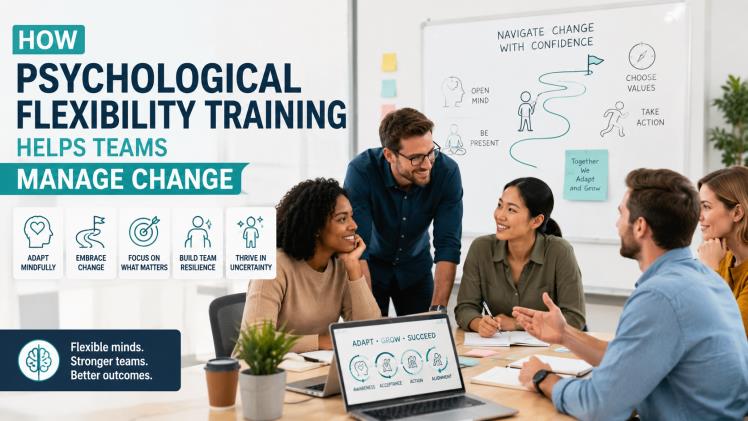
 Workplace change is constant, whether it comes from restructuring, new technology, or shifting market conditions. How teams respond to that change often matters more than the change itself in determining overall performance.
What psychological flexibility actually means
At its core, psychological flexibility is the ability to stay focused on what matters while adapting behaviour in response to changing circumstances, rather than getting stuck in rigid thinking or avoidance when things shift.
Structured training in psychological flexibility gives teams practical tools to build this capacity, rather than leaving it to develop by chance through trial and error during stressful periods.
Unlike generic resilience training, this approach focuses specifically on the mental patterns that either help or hinder someone’s ability to adapt, giving participants concrete skills rather than vague encouragement to simply cope better.
Why change so often derails teams
Teams frequently struggle with change not because the change itself is unreasonable, but because unhelpful thinking patterns, such as rigid attachment to old processes, make adaptation feel far harder than it needs to be.
Anxiety and uncertainty during periods of change can also lead to avoidance behaviours, where team members disengage or resist rather than actively working through the discomfort that genuine adaptation requires.
Left unaddressed, these patterns compound over time, turning a single change initiative into a longer period of reduced productivity and lower morale than the change itself would otherwise justify.
How training addresses these patterns directly
Psychological flexibility training typically helps participants notice unhelpful thought patterns as they arise, creating a small but important gap between the thought and the automatic reaction that often follows it.
From there, participants practise choosing responses aligned with their actual values and goals, rather than reacting purely out of discomfort or habit, which builds a more deliberate, adaptable way of working.
Practical benefits for teams navigating change
Teams with stronger psychological flexibility tend to communicate more openly during periods of uncertainty, since individuals feel more capable of tolerating discomfort without shutting down or becoming defensive.
This openness supports better problem-solving too, since team members are more willing to explore new approaches rather than clinging to familiar methods purely because they feel safer or more comfortable.
Leaders who model psychological flexibility themselves also set a powerful example, showing teams that adapting openly to change is a strength rather than something to be hidden or apologised for.
Applying this in real workplace situations
During a restructure, for example, flexibility training can help staff separate legitimate concerns worth raising from anxiety-driven resistance that, left unchecked, can stall a necessary and ultimately beneficial change.
This kind of adaptability matters just as much for a growing business navigating its own changes, from staffing shifts to new technology, as it does for a large corporate team.
Similarly, during the introduction of new technology or systems, teams with stronger flexibility tend to move through the initial learning curve more smoothly, treating early mistakes as part of the process rather than a source of shame.
Measuring the impact of training
Organisations that invest in this kind of training often track engagement and wellbeing metrics before and after, alongside more traditional measures like productivity and staff turnover during change periods.
While the benefits are not always immediately visible, many organisations report noticeably smoother transitions during subsequent change initiatives once psychological flexibility has become part of the broader team culture.
Building flexibility into ongoing team culture
Rather than treating this as a one-off training event, embedding flexibility practices into regular team check-ins and leadership conversations helps the skills stay active rather than fading once the initial session ends.
This kind of adaptability matters just as much for a growing small business in Perth navigating its own changes, from staffing shifts to new technology, as it does for a large corporate team, where leaders reinforcing these concepts consistently builds lasting change.
Getting started with your team
Organisations considering this kind of training should look for programs grounded in genuine behavioural science, rather than generic motivational content dressed up in psychological language without real substance behind it.
Starting with leadership before rolling out more broadly often produces better results, since leaders who have internalised these skills themselves are far better placed to model and reinforce them across their teams.
Common misconceptions about this kind of training
Some assume psychological flexibility training is simply about staying positive regardless of circumstances, but genuine flexibility actually involves acknowledging difficult emotions honestly rather than suppressing or ignoring them entirely.
Others worry it is too abstract to apply practically, yet most effective programs focus heavily on concrete, repeatable exercises that participants can use in real situations, not just theoretical concepts discussed once and forgotten.
How this supports individual wellbeing too
Beyond team performance, individuals who build stronger psychological flexibility often report lower stress and greater job satisfaction, since they feel more capable of handling workplace pressures without becoming overwhelmed by them.
Bringing training into everyday leadership conversations
Simple check-in questions during regular one-on-ones, focused on how someone is genuinely managing current changes rather than just task progress, help keep flexibility skills active well beyond a single formal training session.
Over time, this consistent reinforcement builds a team culture where adapting to change becomes a normal, expected part of work, rather than something that triggers anxiety or resistance each time it arises.
The long-term payoff for organisations
Businesses that invest early in this kind of capability tend to handle future disruption with noticeably less friction, since the underlying skills apply to almost any type of change, not just the specific initiative that first prompted the training.
In a business environment where change shows no sign of slowing down, that adaptability increasingly looks less like a nice-to-have and more like a genuine competitive advantage for organisations that take it seriously.
Teams equipped with these skills do not just survive change, they tend to come through it with stronger relationships and clearer purpose than before, which is ultimately the outcome most organisations are aiming for.