
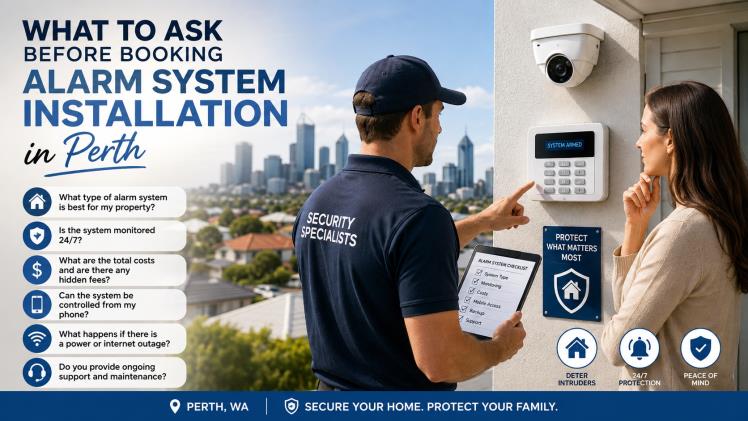
 Booking an alarm installation can feel straightforward until the quotes start arriving and every provider seems to describe a slightly different service. Knowing the right questions to ask upfront saves both money and disappointment once the system is actually in place.
Start with what the system actually covers
Not every quote includes the same equipment. Some cover just entry points, while others extend to motion sensors throughout the home or glass-break detection on vulnerable windows. Ask for a written breakdown before comparing prices between providers.
Getting clear on the scope of alarm system installation early means the final invoice matches expectations, rather than revealing extra charges for sensors that were assumed to be included from the start.
It also helps to walk through the property with the installer beforehand, pointing out specific concerns such as a side gate, a home office, or a garage that stores valuable equipment, so nothing important gets left out of the plan.
Some households also want coverage for outbuildings or granny flats, which is easy to overlook if the initial conversation only focuses on the main residence. Raising this early avoids a scope change and extra cost partway through the job.
Ask about monitoring and response times
A system is only as useful as the response behind it. Ask whether monitoring is included in the quoted price or billed separately, and find out roughly how long verification and dispatch typically take once an alert is triggered.
Some providers monitor in-house, while others outsource to a third party. There is nothing wrong with either approach, but knowing which one applies helps set realistic expectations about accountability if something ever goes wrong with a response.
It is also worth asking what happens during a power outage or internet dropout, since a system that relies entirely on Wi-Fi can leave a property unprotected at exactly the moment it might be needed most, such as during a storm.
Questions about installation and warranty
Find out how long installation typically takes and whether it requires any structural work, particularly in older homes. A same-day install is common for most standard setups, but larger properties may need more than one visit to complete properly.
Warranty terms vary considerably between installers, so ask specifically what is covered and for how long. A provider confident in their equipment will usually offer a warranty that extends well beyond the first few months after installation.
Understand the ongoing costs
Beyond the upfront installation fee, most systems come with an ongoing monitoring or subscription cost. Ask for the full annual figure rather than just the monthly rate, since it is easier to compare providers on a like-for-like basis that way.
It is worth applying the same scrutiny to a business’s own website, and running a blog seo audit every so often can reveal whether marketing content is still pulling its weight the way a security system should.
Cancellation terms deserve attention too. Some contracts lock customers in for a set period with penalties for early exit, while others operate month to month. Understanding this before signing avoids being stuck with a system that no longer suits the household.
Ask for references and reviews
A reputable installer should be comfortable providing recent customer references or pointing to genuine online reviews. Patterns in feedback, whether about response times, professionalism, or after-sales support, tend to reveal more than any single testimonial ever could.
It is also reasonable to ask how long the company has operated locally. Longevity in a competitive market like home security usually reflects consistent service quality, since word of mouth carries a lot of weight in this industry.
Checking whether the installer is licensed and insured is another simple but important step. A legitimate provider will have no hesitation sharing this information, and it protects the household if something goes wrong during the installation itself.
Bringing it all together
None of these questions are unreasonable to ask, and any installer worth hiring should answer them clearly without hesitation. Vague or evasive responses are usually a sign to keep comparing options before committing to a contract.
Taking the time to ask before booking rather than after installation puts homeowners in a far stronger position, both for getting the right system fitted and for knowing exactly what support to expect once it is up and running.
A little preparation before the first phone call also speeds up the quoting process considerably, since installers can give a far more accurate estimate when they already know what coverage and features a household is actually looking for.
Timing the installation around your household
Some households prefer to schedule installation before moving in, so the property is protected from day one and no work needs to happen around furniture, pets, or young children already settled into the home.
Others choose to upgrade an existing system after a specific trigger, such as a break-in nearby or a change in circumstances like working from home more often. Either way, asking about lead times upfront avoids unnecessary delays once a decision is made.
It is also worth asking whether the installer can work around a household’s schedule, particularly for families juggling work and school pickups. A provider offering flexible appointment windows makes the whole process considerably less disruptive.
What happens after installation
A good installer will not simply fit the equipment and leave. Ask whether a walkthrough is included once installation is complete, covering how to arm and disarm the system, test sensors, and understand what each alert actually means.
Ongoing support matters just as much as the initial install. Find out how faults are reported, what the typical turnaround is for a repair visit, and whether call-outs are included in the monitoring fee or charged separately each time.
Finally, ask whether the system will be reviewed periodically as the household changes, since a family’s security needs after five years often look quite different from what they were on the day the system was first installed.