
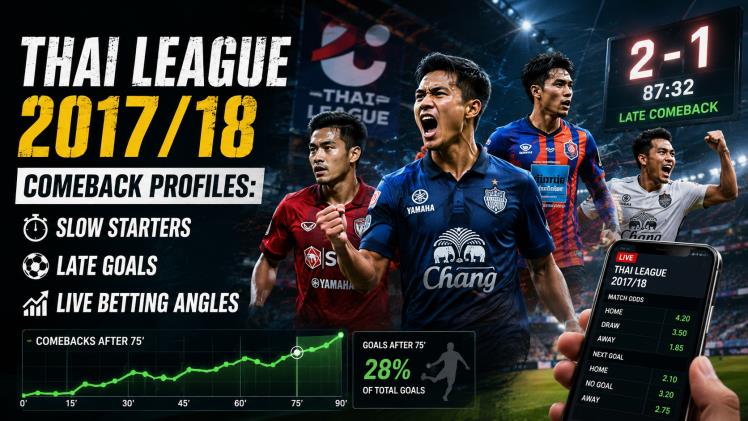
In the 2017 Thai League 1 season there were teams that routinely drifted through the opening stages only to surge once the match entered its final quarter, turning late goals into a recurring identity. These slow‑start, late‑finish profiles did more than excite neutral viewers; they created a specific landscape for live bettors, who could read the emerging script and use in‑play prices to ride comebacks rather than overreact to early deficits.
Why Late-Goal Teams Matter Specifically for Live Betting
Live betting magnifies the value of understanding when a team’s probability of scoring is not constant across the ninety minutes but skewed towards the final stretch. In Thai League matches where some clubs regularly produced a high share of their goals after the 75th minute, early scorelines often misrepresented their true comeback potential, pushing in‑play odds on them to levels that were inconsistent with their historical late‑goal behavior. For bettors who recognized that these sides were structurally more dangerous late on, the cause–effect chain was clear: temporary underperformance early in the match translated into attractive prices that did not yet account for an impending surge in attacking intensity.
The 2017 Thai League Goal-Timing Environment
The 2017 Thai League T1 campaign, with 18 teams and a high average of goals per game, naturally generated a sizable pool of late‑match scoring events. Goal‑time statistics across Thai League seasons show that a significant proportion of goals are typically scored in the final 15 minutes plus stoppage time, as fatigue, tactical risk‑taking and stretched shapes open more space for decisive attacks. Within that broader pattern, some clubs clearly stood out for scoring or conceding disproportionately in the 75–90+ minute window, which is exactly the timeframe live bettors monitor for potential swings in odds and momentum.
Identifying Thai League Teams That Start Slowly but Finish Strong
Late‑goals reports and timing tables for Thai League 1 highlight teams that score a notably higher fraction of their goals in the final quarter compared with league averages. These sides often show a combination of modest first‑half output and elevated late‑goal contributions, leading to a skewed profile where they trail or sit level for long stretches before suddenly piling on pressure and finding the net near the end. In 2017, that pattern tended to emerge among clubs with deeper benches, strong fitness, and attacking options off the bench, as well as those whose tactical plans explicitly aimed to wear opponents down before committing more bodies forward late on.
Mechanisms That Produce Late Surges After Slow Starts
The repeated tendency to “wake up late” rarely stems from a single cause; instead, it arises from interacting tactical, physical and psychological factors. Some Thai League coaches prefer compact, cautious structures early in games, emphasizing risk management and studying the opponent before gradually releasing full‑backs and midfield runners in the second half, which naturally pushes goal probability into the later segments. Fitness edges also matter: teams that can maintain high running intensity as rivals tire often exploit gaps in transition late on, turning previously sterile possession into dangerous counters and overloads around the box.
Comparing Intentional Slow Starts and Forced Late Comebacks
It is important to distinguish between teams that deliberately start cautiously and those forced into late chases because of early mistakes. Intentional slow starters often show relatively low early xG but stable defensive control, then increase shot volume and penalty‑area touches as the match progresses, reflecting a planned gear shift. Forced comeback teams, in contrast, may concede sloppily, then throw numbers forward in desperation, leading to high‑variance late periods where they score and concede freely without the same level of control. Live bettors who can read which of these patterns is in play during the current match are better positioned to decide whether a late‑goal surge is truly backed by structure or just chaos.
Live Game / In-Play Reading as the Core Perspective
Among the listed perspectives, live game / in‑play reading aligns most directly with these slow‑start, late‑finish profiles because the entire edge arises from reacting to evolving match states rather than pre‑match averages alone. A bettor watching Thai League matches in 2017 could combine prior knowledge of a team’s late‑goal tendencies with real‑time cues—substitutions, tactical shifts, shot volume—to decide if a comeback is still plausible when odds have lengthened after an early deficit. The cause–outcome–impact sequence runs from structural late‑goal bias, through in‑match confirmation, to opportunistic entry points on in‑play markets, with each step grounded in observable dynamics rather than superstition.
To make that repeatable, it helps to frame live decisions around specific in‑play triggers rather than vague impressions. The following list captures practical signals that a historically strong late‑goal team is “coming to life” in a way that justifies live positions.
- Substitutions that introduce fresh attacking players around the 60–70 minute mark.
- A clear tactical shift: full‑backs staying higher, an extra forward added, or midfielders stepping into half‑spaces.
- Sustained pressure measured by consecutive corners, dangerous free‑kicks or repeated entries into the final third.
- Opponents defending deeper and clearing long without outlets, indicating mounting fatigue.
- Shot maps tilting heavily towards the late‑surge team after a quiet first hour.
- In‑play odds on that team or on late goals lengthening significantly after an early concession.
- Refereeing leniency that allows the game to flow, increasing the likelihood of end‑to‑end late phases.
Interpreting these triggers together lets bettors avoid overcommitting based only on historical late‑goal stats; instead, they wait for the current match to echo those patterns before acting. For instance, if a known late‑finisher is trailing but shows no tactical change, minimal pressing and little bench impact, then longer odds may be justified and best left alone. Conversely, when that same side floods the box with fresh attackers against a tiring defense, and the shot count spikes, inflated in‑play prices can represent genuine value aligned with both long‑term tendencies and real‑time evidence.
Using Goal-Time Tables and Late-Goals Data
Goal‑time statistics by 15‑minute segments give a concrete way to quantify how extreme a team’s late‑scoring profile actually is compared with typical Thai League patterns. Tables that list goals scored and conceded between 75 minutes and full time allow analysts to classify teams into categories—late‑goal specialists, balanced scorers, or sides that fade badly—which in turn informs how aggressively to pursue live positions when they are behind. These numbers also highlight whether a team’s late‑goal habit is driven more by frequent comebacks at home, where crowd support and familiarity matter, or by away performances where counterattacking opportunities often increase as hosts chase winners.
Once those categories are defined, bettors can construct simple matrices that match late‑finishing teams against opponents with opposing tendencies—for example, hosts who routinely concede late under pressure. When a proven late‑surge team trails such an opponent, live odds that treat the deficit as nearly decisive may overlook the structural mismatch in stamina, tactical flexibility and bench quality. Conversely, facing rivals who themselves excel late on, even strong Thai League finishers may not justify aggressive live support, because the closing phase becomes more of a coin‑flip between two energized attacks. In that way, goal‑time data acts as a map for selecting which specific in‑play deficits are worth targeting.
Implementing Live Betting Decisions in Practice
Turning a theoretical edge on late‑goal teams into actual profit requires translating insights into specific in‑play markets at the right price levels. Common tools include backing the late‑finish side on the live moneyline when trailing by a single goal, taking them on a 0 or +0.5 Asian handicap for the remaining time, or backing over goals in the final 15 minutes when both teams show signs of fatigue and stretched play. The key is to calibrate stake size to both the magnitude of the live edge and the inherent volatility of late‑match betting, where small incidents—cards, injuries, a missed sitter—can swing outcomes dramatically in a short timespan.
At this point, execution quality becomes as important as analysis. When a bettor expects to take advantage of rapid odds movements in Thai League matches, they need a live‑betting environment that keeps pace with both market and match tempo rather than lagging behind. In this operational context, some users evaluate whether a particular betting interface—say, the in‑play section of ufabet—provides sufficiently quick market updates, diverse late‑goal and comeback lines, and clear cash‑out mechanics to support a strategy built on fast‑evolving late‑match patterns. The analytical thesis about slow starts and late surges stays the same, but the ability to capitalize on it depends heavily on how efficiently that interface allows orders to be placed at the moments when edge is greatest.
When the Late-Comeback Narrative Breaks Down
The idea of certain teams being “made for comebacks” is appealing, but it can mislead when underlying conditions change or when randomness dominates small samples. Changes in coaching style, aging of key attackers, or departures of super‑sub forwards can all erode a team’s late‑goal production, even if historical stats still look impressive. Injuries or congested schedules may also invert patterns temporarily, leaving previously strong finishers running out of gas earlier and conceding late instead of scoring. If live bettors cling to a dated narrative without checking current season trends, they risk backing comebacks that the present‑day squad is no longer equipped to deliver.
Moreover, markets adapt: once a team’s reputation for dramatic late strikes becomes well known, in‑play odds may no longer drift as far when that side falls behind, compressing potential value. In that situation, even accurate reads on their comeback potential may not translate into positive expected value because competition has priced the narrative in. Finally, variance is especially brutal in the final minutes—posts, keeper heroics and marginal offside calls can derail statistically sound positions—so any strategy built on late‑goal tendencies must incorporate conservative staking and a long‑term horizon rather than chasing instant gratification.
Balancing Live-Play Edges with Broader Gambling Behavior
Live betting on Thai League late‑finish teams is inherently adrenaline‑heavy, which can blur the line between strategy and impulse if not kept in check. The rapid swings in both odds and emotions during the last 15 minutes can tempt bettors to increase stakes beyond their plan or to carry that appetite for fast outcomes into other, less analytically grounded forms of wagering. To preserve the value of a carefully constructed live‑play approach, it is important to separate it from any high‑variance, entertainment‑driven activity handled elsewhere.
One effective method is to define distinct bankroll slices and rules: a capped allocation for data‑driven live betting in Thai League matches, with clear criteria for entering and exiting positions, and a separate, strictly limited portion for any other gambling, whether on different sports or in a casino online website. That structural separation helps ensure that a wild late comeback or a heart‑breaking near‑miss does not trigger a cascade of impulsive bets in unrelated markets. Instead, each live‑betting session can be reviewed on its own merits—were the entries justified by both historical late‑goal data and in‑match signals?—so that learning compounds over time rather than being drowned out by emotional noise from other gambling domains.
Summary
The 2017 Thai League season underscored how some teams combined slow starts with powerful late surges, turning goal‑time asymmetries into a distinct live‑betting opportunity for those who read matches in real time. By anchoring decisions in goal‑segment data, recognizing the tactical and physical mechanisms behind late comebacks and using in‑play triggers to decide when a deficit truly represents value, bettors can move beyond narrative and treat these patterns as one structured edge among many. The sustainability of that edge ultimately depends on disciplined execution—choosing the right matches, staking with variance in mind and keeping live‑betting strategies insulated from less analytical gambling impulses—so that the drama of Thai League late goals enhances, rather than undermines, long‑term decision quality.