
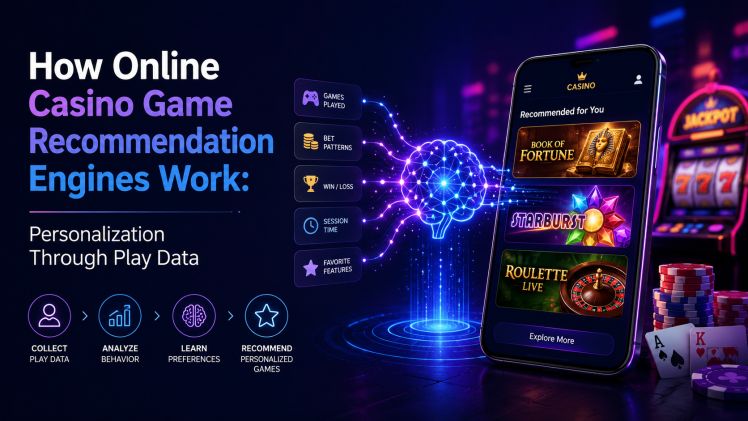
Picture this: a player finishes a session on a high-volatility slot, logs out, and returns the next evening to find a curated row of game matching exactly that risk appetite, medium-to-high variance titles from Pragmatic Play, none of the low-stakes table games they never touched. That is not coincidence. It is a recommendation engine doing precisely what it was built to do: read behavioral signals and convert them into a frictionless next step. The logic behind that row of suggestions is more intricate than it first appears.
The Data Foundation: What Platforms Actually Collect
Every spin, bet size, session length, and game exit point generates a data record. Recommendation systems aggregate these into a behavioral profile that updates continuously, not just at the end of a session. A player who consistently bets $2.50 per spin, plays for 35-minute windows, and gravitates toward bonus-buy features produces a distinct fingerprint that differs sharply from someone placing $0.20 bets across 90-minute casual sessions. The engine treats each variable as a weighted input, not a binary flag.
Collaborative filtering sits at the core of most iGaming recommendation architectures. The model identifies clusters of players whose histories resemble each other, then surfaces games enjoyed by the cluster that the individual has not yet tried. Pragmatic Play’s internal data team and NetEnt’s analytics division both publish technical breakdowns showing how session-length similarity outperforms genre preference alone as a clustering variable. Platforms like Pinco Casino integrate session-aware recommendation layers that adjust suggestions based on live play data rather than static preference profiles, reflecting how competitive the personalization standard has become. Add real-time context, time of day, device type, deposit amount in the current session, and the model refines further, narrowing from a cluster of 10,000 similar players to a cohort of a few hundred.
Bet Pattern Signals and Volatility Matching
Bet sizing relative to session bankroll is one of the stronger predictive signals available. A player depositing $50 and opening at $1.00 per spin is signaling comfort with roughly 2% stake-to-bankroll ratios, which maps statistically to preference for mid-to-high-variance titles. The engine can match that ratio against game volatility classifications provided directly by studios, Play’n GO, for instance, labels its titles on a 1-to-5 volatility scale in its B2B documentation, giving operators a structured input for matching.
How Retention Economics Drive Personalization Investment
The commercial case for recommendation engines is straightforward once the acquisition numbers are clear. Customer acquisition cost in iGaming ranges from $250 to $500 per user under normal conditions and climbs past $800 during major sports events, making retention leverage substantial. Retaining an existing player costs roughly one-fifth to one-seventh of acquiring a new one, so every percentage point gained through personalization carries real margin weight. Platforms deploying AI-driven recommendation tools report conversion rate increases of up to 50% and revenue lifts between 5% and 15%, figures that justify significant engineering spend.
One documented real-world deployment illustrates the scale of impact: a real-time AI personalization rollout in iGaming produced a 38% increase in Day-30 player retention alongside a 22% rise in average player lifetime value, while simultaneously cutting bonus spend per active user by 27%. That last figure matters, if the engine surfaces the right game at the right moment, the platform needs to offer less promotional incentive to re-engage.
Churn prediction adds a second layer to the retention model. Behavioral churn models in iGaming can detect elevated churn risk 7 to 14 days before a player goes inactive, giving operators a meaningful intervention window. Personalized game promotions or targeted bonus offers launched within that window recover between 15% and 30% of at-risk players, according to published iGaming analytics benchmarks. The recommendation engine and the churn model share the same behavioral data pipeline, making them functionally integrated rather than separate systems.
Industry Scale and Responsible Design Considerations
The global AI gambling market is projected to reach $10 billion by 2027, with over 70% of major online gambling operators already having integrated AI-powered recommendation and personalization tools. That saturation changes the competitive baseline: personalization is no longer a differentiator but an operational minimum. Operators lagging on recommendation sophistication face measurable disadvantages in session depth and repeat deposit rates, with one industry analysis citing a 41% increase in repeat deposits attributable directly to real-time personalization.
Regulatory scrutiny of recommendation engines is intensifying alongside adoption. Several licensing frameworks now require that personalization systems include friction mechanisms, cooling-off prompts triggered by session length thresholds, stake escalation warnings when bet size increases sharply mid-session, and opt-out tools for players who prefer non-personalized browsing. Studios including Evolution Gaming and Microgaming have incorporated configurable RTP transparency displays, which operators can surface within recommendation carousels to give players verifiable return data alongside the suggestion. A slot recommendation that also shows an audited 96.1% RTP presents meaningfully more information than a bare thumbnail. Balancing engagement optimization with disclosure requirements is now a live engineering challenge, not a compliance afterthought, for any platform running a serious recommendation layer.